Find Your Wind
Beyond ADHD Life Hacks: Building a Process That Works with Your Brain
Why lasting progress begins at the beginning.
We live in a world of shortcuts.
Search the internet for ways to manage ADHD, and you will find countless life hacks promising better focus, improved productivity, stronger time management, and greater organization, such as:
- Use a particular planner
- Set more alarms
- Break tasks into smaller pieces
- Try a new app
- Establish a morning routine
These strategies can be helpful, and many people with ADHD benefit from them. But there is a fundamental question we often fail to ask:
Are we trying to fix individual problems, or are we building a process that helps a person function more effectively over time?
For someone with ADHD, a strategy that works today may stop working tomorrow. A new planner creates excitement for a week, but eventually gets forgotten. A morning routine feels productive until one unexpected event disrupts the entire day. A list of goals inspires action, but too many possibilities create, overwhelm, and lead to inaction.
When these strategies fail, people may conclude that they lack discipline, consistency, or motivation. In reality, the problem may not be lack of effort. They may be trying to force themselves into a system that was never designed for the way they function. Life hacks can address individual challenges, but without an underlying process, they can become another collection of things to start, maintain, abandon, and replace.
Start at the beginning: Understand before you optimize
Before we can build an effective process for living with ADHD, we must begin by understanding the person.
How do you respond to structure?
What creates energy and engagement for you?
What causes "overwhelm"?
When is your focus the strongest?
What happens when several good opportunities compete for attention?
What does the transition from productive period to exhaustion look like?
These are not questions that a universal productivity hack can answer. They require observation, honesty, and a willingness to learn from experience.
The goal is not to make every person with ADHD to operate the same way. The goal is to understand individual patterns and build around them.
For one person, that might mean completing the most demanding task early in the day.
For another person, it may mean using external reminders, working alongside another person, or alternating periods of concentration with movement.
It may also mean learning to recognize when energy is depleted rather than interpreting every unproductive moment as a personal failure.
You cannot build a sustainable process until you understand the person the process is meant to serve.
Build a foundation before adding more tools.
Once we understand the individual, we can begin building a foundation. That foundation should establish priorities, realistic expectations, repeatable routines, and a way to recover when the day does not go as planned. Instead of trying to improve every area of life at once, start with a few controllable actions.
- Establish a consistent starting point for the day.
- Identify one meaningful priority.
- Create a simple method for capturing distracting ideas so they don’t have to be pursued immediately.
- Develop a plan for resetting when attention wanders or energy drops.
This is where small steps become more powerful that ambitious plans. A process should be simple enough to repeat, flexible enough to adapt, and forgiving enough to survive an imperfect day. It should not depend entirely on feeling motivated. It should provide a path forward even when motivation is absent. Over time, the process can be refined through experience. When something works, understand why. When something fails, examine the conditions rather than automatically blaming yourself. The purpose is not to create a perfect routine; it is to develop a reliable way of returning to the path.
Adapt the process instead of fighting yourself
Living effectively with ADHD often requires learning to work with your patterns rather than constantly fighting them. That does not mean avoiding responsibility, abandoning goals, or accepting every difficulty as unchangeable. It means recognizing that the route to a goal may need to look different from the route someone else takes. A process that allows for changing energy levels, distractions, interruptions, and shifting conditions can be more sustainable than one that demands perfect consistency.
This is an important distinction:
Consistency does not mean doing everything the same way every day. It means consistently returning to a process that helps you move forward.
Some days will require greater structure. Other days will call for rest, a change in environment, or a smaller definition of success. The process should help you recognize those differences and respond intentionally. When the process stops working, you do not have to abandon the entire system. You can evaluate it, make adjustments, and continue learning.
Learning to Fly: Finding the conditions that help you move forward
Imagine learning to pilot a hot-air balloon. You would not begin by collecting shortcuts for flying faster. You would first learn how the balloon works, understand the equipment, recognize the conditions, and develop the skills required to operate it safely. You would learn that the wind changes with altitude and that reaching a destination is not always about applying more heat or fighting harder against the conditions. Sometimes you must adjust your altitude to find a wind that moves you in the right direction.
The same principle can apply to building a life with ADHD. You cannot control every thought, distraction, interruption, or change in energy. But you can learn to recognize your patterns, establish a foundation, adjust your environment, and develop a process that helps you navigate those conditions. Instead of demanding that your brain function like everyone else’s, you can learn how to operate your own system more effectively.
This is not about finding one perfect hack that finally makes everything easy. It is about developing a deeper understanding of yourself and building a process that grows with you.
Progress through intentional action
The real opportunity is to move beyond the endless search for the next productivity trick and begin building a life around intentional, sustainable action. Start small. Establish a foundation. Identify what works. Learn from what does not. Make adjustments without abandoning your purpose. Repeat the process.
At A Momentum-Based Life, the belief is that consistent, intentional action compounds over time. Progress does not require a perfect day, and one difficult day does not erase the progress already made. What matters is learning how to return to the process and take the next meaningful step.
Stop searching for the perfect hack. Start building the process that helps you move forward.
Five Foundational Principles for Building a Life That Works With ADHD
These five principles can become the framework for building a Momentum-Based Life approach to ADHD. The objective is not to eliminate every challenge or find a shortcut to perfect productivity. It is to build a sustainable process that helps a person understand themselves, adapt to their needs, and make consistent progress.
1.Understand the Individual (Self-awareness before strategy)
Before attempting to change behavior, take time to understand how your ADHD affects your daily life. Recognize when your energy is strongest, what captures your attention, what creates overwhelm, and what conditions make it easier to concentrate. Pay attention to recurring patterns without judging yourself for them.
The principle: You cannot build an effective process until you understand the person the process is designed to serve.
2. Build the Foundation (Structure before shortcuts)
Create a basic framework for your day before adding more productivity tools. Establish a starting routine, identify priorities, capture distracting ideas somewhere reliable, and decide how you will return to a task after an interruption. Keep the system simple enough to use even when motivation is low.
The principle: Build a dependable foundation before adding more tools, tactics, and expectations.
3. Start with Controllable Actions (Small steps create momentum)
ADHD can make large projects, competing opportunities, and ambitious plans difficult to organize into action. Instead of trying to solve everything at once, identify one meaningful task and determine the smallest useful step you can take. Completing that step creates a starting point for the next one.
The principle: You do not need to control the entire day to make meaningful progress. Control the next action.
4. Adapt the Process to the Conditions (Flexibility instead of constant resistance)
A process should support you through changing circumstances rather than demand identical performance every day. When your energy drops, reduce the size of the task. When distractions increase, change your environment. When an approach stops working, examine the conditions and adjust the method.
Think of learning to fly a hot-air balloon: reaching your destination is not always about applying more heat. Sometimes you must change altitude to find a more favorable wind. Similarly, progress with ADHD may require adjusting your approach rather than pushing harder against conditions that are not working.
The principle: Adapt the process without abandoning the purpose.
5. Review, Refine, and Return (Consistency through intentional repetition)
No process will work perfectly all the time. The goal is to develop a reliable way to recognize what is working, learn from what is not, and make adjustments without starting over every time something goes wrong. A difficult day becomes information, not a verdict on your character. Progress comes from returning to the process and taking the next useful step.
The Principle: Consistency is not perfection. It is the ability to return to a process. Learn, and continue moving forward.
Repeat the process. Each cycle creates an opportunity to learn and improve.
Central Message:
You cannot regenerate a system simply by demanding more from it. You must understand how it functions, establish the right foundation, and create conditions in which it can thrive.
The above principle applies to soil health, personal growth, and the way we approach ADHD. A garden cannot thrive through fertilizer alone if the underlying soil conditions remain unsuitable. Likewise, a person with ADHD may not find lasting progress by continually collecting productivity hacks without understanding their own patterns and building a process around them.
Life hacks can still be useful. They become more effective when they serve a larger system rather than substitute for one.
The goal is not to build a life in which you never struggle. It is to build a process that helps you navigate the struggle without losing your direction.
A Momentum-Based Life: Understand yourself. Build your foundation. Take intentional action. Adapt to the conditions. Return to the process.

Simplified from above! Building a Process > Life Hacks
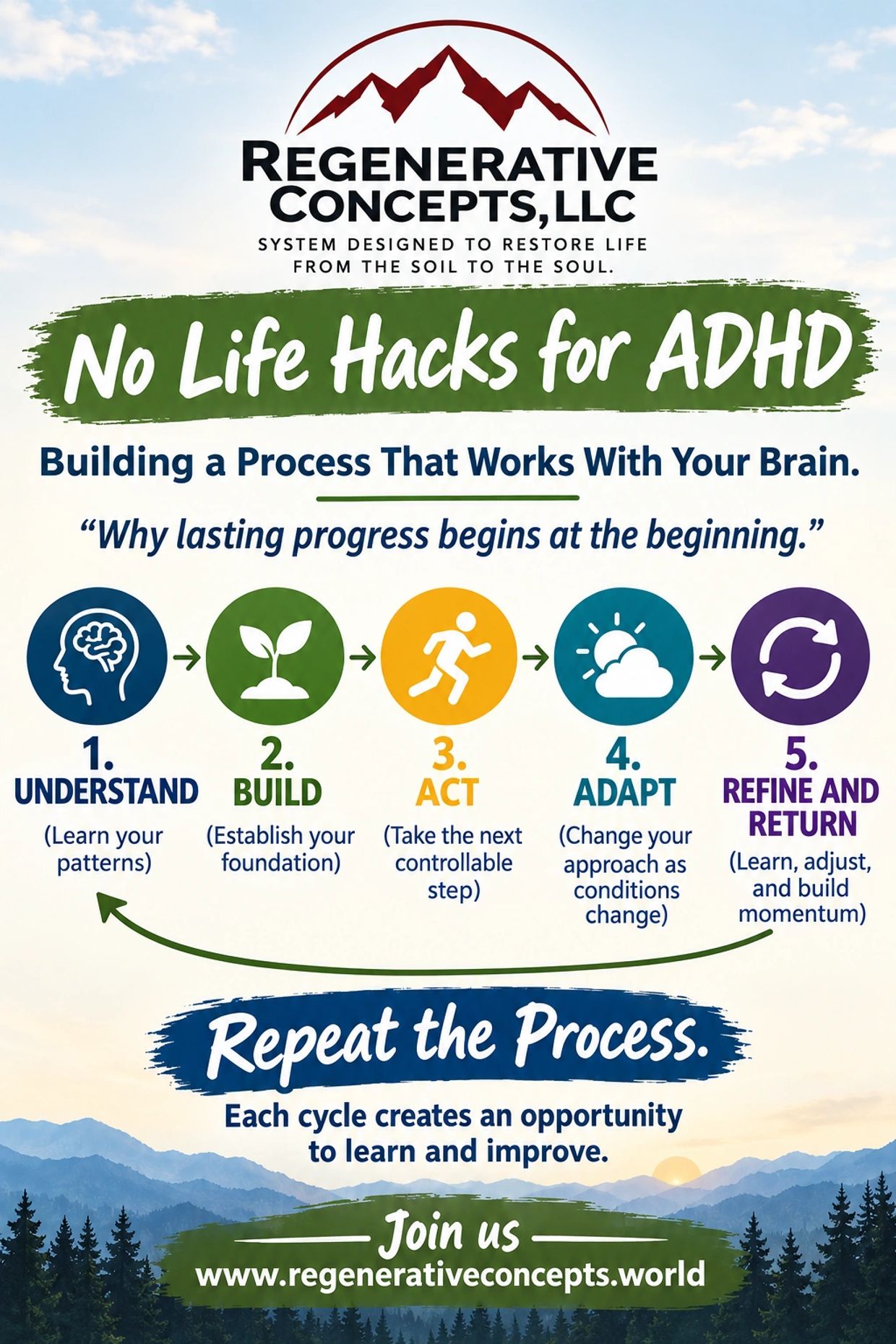
Shortcuts can be unsustainable because they bypass critical foundational work, build the process
Regenerative Concepts - A system designed to help restore life from the soil to the soul.